Dans cet enregistrement consacré aux trois quatuors à cordes d’Alberto Ginastera (Quatuor à cordes N°1 Op.20 (1948), Quatuor à cordes N°2 Op.26 (1958, révisé en 1968), Quatuor à cordes N°3 Op.40 (1973, révisé en 1978) avec voix « Kiera Duffy, soprano ») le Quatuor Miró rend pleinement justice à l’un des compositeurs latino américains les plus marquants du XXe siècle. Né à Buenos Aires en 1916 et mort à Genève en 1983, ce dernier fit ses études au Conservatoire Williams puis au Conservatoire national, s’imposa d’abord par un nationalisme musical nourri de folklore argentin avant d’évoluer vers un langage moderniste et néo expressionniste intégrant sérialisme, micro intervalles et polytonalité, tout en poursuivant une carrière internationale marquée par des œuvres emblématiques comme « Estancia » (1941), ses opéras « Don Rodrigo » (1964), « Bomarzo » (1967) et « Beatrix Cenci » (1971). Fondé en 1995 et résident à Austin, le Quatuor Miró , lauréat des concours de Banff et Naumburg et premier ensemble à recevoir l’Avery Fisher Career Grant, s’est imposé comme l’un des quatuors américains les plus célébrés, reconnu pour son intensité interprétative, son engagement pédagogique et une discographie saluée, notamment chez Pentatone où il poursuit une collaboration fructueuse. Dans ce programme, les musiciens (Daniel Ching, violon, William Fedkenheuer, violon, John Largess, alto, Joshua Gindele, violoncelle) embrassent avec une énergie physique irrésistible le cycle complet des quatuors de Ginastera, qui retrace l’évolution stylistique du compositeur, du premier quatuor aux couleurs folkloriques et à la rythmique incisive, au deuxième plus âpre et structuré par des procédés sériels, jusqu’au troisième, œuvre tardive d’une intensité presque visionnaire, révélant un univers sonore où se mêlent lyrisme, tension dramatique et éclats fantastiques. Bref, une interprétation d’une force expressive indéniable qui souligne la cohérence profonde et la puissance narrative de ces partitions.
Jean-Jacques Millo In this recording dedicated to Alberto Ginastera’s three string quartets (String Quartet No. 1, Op. 20 (1948), String Quartet No. 2, Op. 26 (1958, revised in 1968), String Quartet No. 3, Op. 40 (1973, revised in 1978) with voice “Kiera Duffy, soprano”, the Miró Quartet does full justice to one of the most influential Latin American composers of the 20th century. He was born in Buenos Aires in 1916 and died in Geneva in 1983, and studied at the Williams Conservatory and then at the National Conservatory, first establishing himself through a musical nationalism rooted in Argentine folklore before evolving toward a modernist and neo-expressionist language incorporating serialism, microintervals, and polytonality, all while pursuing an international career marked by iconic works such as “Estancia” (1941) and his operas “Don Rodrigo” (1964), “Bomarzo” (1967), and “Beatrix Cenci” (1971). Founded in 1995 and based in Austin, the Miró Quartet—winner of the Banff and Naumburg competitions and the first ensemble to receive the Avery Fisher Career Grant—has established itself as one of the most celebrated American quartets, recognized for its interpretive intensity, its educational commitment, and an acclaimed discography, notably with Pentatone, with whom it continues a fruitful collaboration. In this program, the musicians (Daniel Ching, violin; William Fedkenheuer, violin; John Largess, viola; Joshua Gindele, cello) tackle Ginastera’s complete cycle of string quartets with irresistible physical energy, tracing the composer’s stylistic evolution— from the first quartet, with its folk-inspired colors and incisive rhythms, to the second, more austere and structured by serial techniques, and on to the third, a late work of almost visionary intensity, revealing a sonic universe where lyricism, dramatic tension, and fantastical bursts intermingle. In short, a performance of undeniable expressive power that highlights the profound coherence and narrative force of these scores.
Translation Lawrence Schulman | 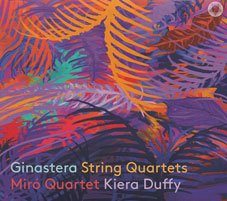 |