HK Gruber et le Swedish Chamber Orchestra signent ici une lecture d’une belle cohérence stylistique où la satire du « ballet chanté » « Les Sept Péchés Capitaux » de Kurt Weill (1900-1950), datant de 1933, donnée dans la traduction anglaise de W. H. Auden et Chester Kallman, retrouve toute sa virulence, son ironie mordante et son mélange si particulier de cabaret, de jazz, et de lyrisme inquiet. Wallis Giunta, qui incarne les deux Anna, impose une articulation exemplaire et une présence vocale lumineuse, rendant le récit parfaitement intelligible et psychologiquement nuancé, tandis que le quatuor masculin, parfois moins net dans la diction, apporte la couleur attendue. Le programme se prolonge avec « The New Orpheus » Op.15 (1925), cantate expressionniste pour soprano, violon seul (Katarina Andreasson) et orchestre, où Jennifer France déploie une vocalité souple et lumineuse au cœur d’un orchestre fragmenté, et avec le « Concerto pour violon et orchestre à vents » Op.12 (1924), en quatre mouvements, dont la partie soliste est confiée à Benjamin Herzl, mettant en valeur l’énergie rythmique, la théâtralité précoce et les audaces harmoniques du jeune Weill . Figure majeure de la scène musicale contemporaine, HK Gruber (né en 1943), est un compositeur, chansonnier, acteur, chef d’orchestre autrichien, héritier direct de la tradition viennoise du cabaret moderniste. Il s’est imposé depuis les années 1980 comme l’un des interprètes les plus pénétrants de Kurt Weill : son expérience de la satire musicale, son sens du théâtre, sa connaissance intime des textures orchestrales et son goût pour les hybridations stylistiques en font un guide idéal dans cet univers où le populaire et le sophistiqué se mêlent sans cesse. La prise de son stéréo et multicanal, ample, précise et d’une neutralité exemplaire, signée Christian Starke, magnifie les couleurs instrumentales et la dynamique, offrant un triptyque parfaitement construit qui éclaire autant la veine satirique que l’inventivité orchestrale d’un compositeur à la croisée des mondes.
Jean-Jacques Millo HK Gruber and the Swedish Chamber Orchestra deliver a performance of remarkable stylistic coherence, in which the satire of Kurt Weill’s (1900–1950) sung ballet The Seven Deadly Sins by Kurt Weill (1900–1950), dating from 1933 and presented in the English translation by W. H. Auden and Chester Kallman, regains all its virulence, biting irony, and unique blend of cabaret, jazz, and restless lyricism. Wallis Giunta, who embodies both Annas, delivers exemplary articulation and a luminous vocal presence, rendering the narrative perfectly intelligible and psychologically nuanced, while the male quartet, at times less precise in diction, provides the expected color. The program continues with “The New Orpheus” Op. 15 (1925), an expressionist cantata for soprano, solo violin (Katarina Andreasson), and orchestra, in which Jennifer France displays a supple and luminous vocalism at the heart of a fragmented orchestra, and with the “Concerto for Violin and Wind Orchestra ” Op. 12 (1924), in four movements, with the solo part entrusted to Benjamin Herzl, highlighting the rhythmic energy, precocious theatricality, and harmonic audacity of the young Weill. A major figure in the contemporary music scene, HK Gruber (born in 1943) is an Austrian composer, singer-songwriter, actor, and conductor, a direct heir to the Viennese tradition of modernist cabaret. Since the 1980s, he has established himself as one of the most insightful interpreters of Kurt Weill: his experience with musical satire, his sense of theater, his intimate knowledge of orchestral textures, and his taste for stylistic hybridizations make him an ideal guide in this universe where the popular and the sophisticated constantly intertwine. The stereo and multichannel recording, spacious, precise, and of exemplary neutrality, by Christian Starke, magnifies the instrumental colors and dynamics, offering a perfectly constructed triptych that illuminates both the satirical vein and the orchestral inventiveness of a composer at the crossroads of worlds. Translation Lawrence Schulman | 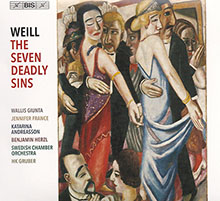 |