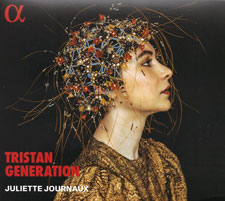
Avec « Tristan Generation » la pianiste française, Juliette Journaux, signe un deuxième album ambitieux, qui confirme la singularité de son univers artistique et son intérêt profond pour les territoires expressifs situés à la frontière du romantisme et de la modernité (voir Interview). Le programme de l’enregistrement constitue une exploration de l’héritage wagnérien et de ses prolongements dans la musique germanique au tournant des XIXe et XXe siècles. « Tristan und Isolde », dont la création en 1865 a ouvert de nouvelles perspectives harmoniques et expressives, en repoussant les limites de la tonalité et en faisant de la tension, de l’attente et du désir des éléments fondamentaux du discours musical, en est le fil conducteur. C’est cette onde de choc que Juliette Journaux entreprend de suivre, en convoquant plusieurs générations de compositeurs, dans un parcours qui réunit Richard Wagner (1813-1883), Arnold Schoenberg (1874-1951), Alexander von Zemlinsky (1871-1942), Walter Braunfels (1882-1954), Hugo Wolf (1860-1903), Franz Liszt (1811-1886), Franz Schreker (1878-1934) et Erich Wolfgang Korngold (1897-1957). En signant une grande partie des transcriptions pour piano, Juliette Journaux offre un espace de transfiguration orchestrale et poétique, capable de restituer les couleurs, les voix intérieures et les multiples dimensions expressives d’une partition, comme notamment celle de « La Scène du Philtre » de Tristan où il s’agit de faire entendre toute la richesse harmonique et la puissance dramatique de l’écriture wagnérienne. Elle dessine ainsi une véritable généalogie musicale, faisant apparaître les filiations, les ruptures et les métamorphoses qui relient Wagner aux compositeurs du début du XXe siècle. Tout cela suppose une connaissance intime des œuvres, une grande imagination sonore et une maîtrise de l’écriture qui dépasse largement les exigences habituelles de l’interprétation pianistique. A l’évidence, Juliette Journaux est une musicienne attachante, que l’on suivra avec un intérêt artistique et intellectuel, pour son originalité et sa profondeur indéniables.
With Tristan Generation, French pianist Juliette Journaux presents an ambitious second album that confirms the unique nature of her artistic world and her profound interest in expressive realms situated at the intersection of Romanticism and modernity (see interview). The recording’s program explores the Wagnerian legacy and its evolution within Germanic music at the turn of the 19th and 20th centuries. The central thread is Tristan und Isolde—a work whose 1865 premiere opened new harmonic and expressive horizons by pushing the boundaries of tonality and establishing tension, anticipation, and desire as fundamental elements of musical discourse. Juliette Journaux sets out to trace this shockwave, bringing together several generations of composers in a journey that encompasses Richard Wagner (1813–1883), Arnold Schoenberg (1874–1951), Alexander von Zemlinsky (1871–1942), Walter Braunfels (1882–1954), Hugo Wolf (1860–1903), Franz Liszt (1811–1886), Franz Schreker (1878–1934), and Erich Wolfgang Korngold (1897–1957). By creating many of the piano transcriptions herself, Journaux provides a space for orchestral and poetic transfiguration—one capable of capturing the colors, inner voices, and multifaceted expressive dimensions of a score. A notable example is the “Potion Scene” from Tristan, in which she brings out the full harmonic richness and dramatic power of Wagner’s writing. In doing so, she maps out a true musical genealogy, revealing the lineages, ruptures, and metamorphoses that connect Wagner to the composers of the early 20th century. All of this presupposes an intimate knowledge of the works, a vivid sonic imagination, and a command of composition that far exceeds the usual demands of piano performance. Clearly, Juliette Journaux is a compelling musician—one whose career will be followed with both artistic and intellectual interest, given her undeniable originality and depth. Translation Lawrence Schulman Jean-Jacques Millo |