Sergueï Rachmaninov (1873-1943), compositeur auquel il voue une admiration profonde depuis ses années d’apprentissage, et dont il explore ici les multiples visages, entre virtuosité flamboyante, mélancolie slave, lyrisme intimiste et profondeur, est une évidence pour Dmitry Masleev. Né en 1988 à Oulan-Oudé, en Sibérie orientale, ce dernier découvre le piano à l’âge de sept ans, à la suite d’une erreur de salle lors d’un examen auquel il devait se présenter pour intégrer une classe de mathématiques ! Cette heureuse méprise va déterminer toute son existence. Après ses premières études musicales dans sa ville natale, il rejoint le Conservatoire Tchaïkovski de Moscou, où il travaille auprès du professeur Mikhaïl Petoukhov, dont il suit également l’enseignement en cycle de perfectionnement, avant de poursuivre sa formation à l’Académie internationale de piano du lac de Côme, en Italie. Son parcours est rapidement jalonné de distinctions internationales, notamment au concours Adilia Alieva de Gaillard en 2010, au concours Chopin de Rome en 2011 et au concours Antonio Napolitano de Salerne en 2013. Mais c’est en 2015 que sa carrière prend une dimension internationale avec l’obtention du premier prix et de la médaille d’or du prestigieux Concours international Tchaïkovski de Moscou. Avec cet enregistrement Dmitry Masleev nous invite à découvrir le compositeur russe à travers une sélection d’œuvres célèbres et de pièces plus rares, réunies sous le titre évocateur de « Fragments », comme autant de fenêtres ouvertes sur une richesse musicale inépuisable. Le programme nous entraîne notamment dans les « Études-tableaux » op. 33, avec les numéros 8 en ut dièse mineur, 4 en ré mineur, 7 en sol mineur et 6 en mi bémol majeur. Ces pages, véritables tableaux sonores où Rachmaninov associe puissance expressive, imagination orchestrale et exigences pianistiques, permettent, au musicien, de déployer toute l’étendue de son art. Viennent ensuite « Élégie en mi bémol mineur », extraite des Morceaux de fantaisie op. 3, « Deux romances », op. 4 n° 4 et op. 21 n° 7, proposées dans des transcriptions pour piano réalisées par Masleev lui-même, le célèbre « Prélude en ut dièse mineur », extrait des Morceaux de fantaisie op.3, « Études-tableaux », n° 4 en si mineur et 9 en ré majeur de l’opus 39, « Variations Corelli » Op.42 et « Vocalise » dans sa version pour piano signée Alan Richardson. Bref, voici un des pianistes russe les plus intéressants de sa génération.
Jean-Jacques Millo Sergei Rachmaninoff (1873–1943)—a composer for whom Dmitry Masleev has held a deep admiration since his formative years—is a natural choice for the pianist. In this collection, Masleev explores the many facets of Rachmaninoff’s musical world, ranging from flamboyant virtuosity and Slavic melancholy to intimate lyricism and profound depth. Born in 1988 in Ulan-Ude, Eastern Siberia, Masleev discovered the piano at the age of seven—the result of a mix-up that led him into the wrong room for an entrance exam, which was actually intended for a mathematics class! This fortunate misunderstanding would shape the entire course of his life. Following his initial musical studies in his hometown, he enrolled at the Tchaikovsky Conservatory in Moscow, where he studied under Professor Mikhail Petukhov—continuing with him through an advanced-level program—before further refining his craft at the International Piano Academy Lake Como in Italy. His career was soon marked by a series of international accolades, including prizes at the Adilia Alieva Competition in Gaillard (2010), the Chopin Competition in Rome (2011), and the Antonio Napolitano Competition in Salerno (2013). However, it was in 2015 that his career truly reached the international stage, when he won the First Prize and Gold Medal at the prestigious International Tchaikovsky Competition in Moscow. With this recording, Dmitry Masleev invites us to explore the Russian composer through a selection of both celebrated works and rarer pieces, brought together under the evocative title “Fragments”—each serving as a window into an inexhaustible musical richness. The program notably features selections from the Études-tableaux, Op. 33: No. 8 in C-sharp minor, No. 4 in D minor, No. 7 in G minor, and No. 6 in E-flat major. These pieces—veritable sonic tableaux in which Rachmaninov combines expressive power, orchestral imagination, and demanding pianistic requirements—allow the musician to display the full scope of his artistry. The program continues with the Élégie in E-flat minor (from Morceaux de fantaisie, Op. 3); two romances (Op. 4, No. 4 and Op. 21, No. 7), presented in piano transcriptions by Masleev himself; the famous Prelude in C-sharp minor (from Morceaux de fantaisie, Op. 3); the Études-tableaux (Op. 39, No. 4 in B minor and No. 9 in D major); the Corelli Variations, Op. 42; and Vocalise in a piano arrangement by Alan Richardson. In short, here is one of the most compelling Russian pianists of his generation. Translation Lawrence Schulman | 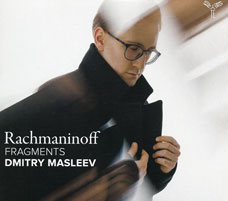 |