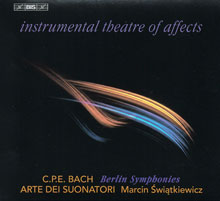
Voici six symphonies de Carl Philipp Emanuel Bach (1714-1788), composées entre 1755 et 1758, durant sa longue période berlinoise, alors qu’il était au service de Frédéric II de Prusse. La Symphonie en sol majeur Wq 173, la Symphonie en fa majeur Wq 175, la Symphonie en ré majeur Wq 176, la Symphonie en mi mineur Wq 178, la Symphonie en mi bémol majeur Wq 179 et la Symphonie en sol majeur Wq 180. Elles appartiennent à un corpus de huit symphonies composées à Berlin et témoignent d’une période particulièrement importante dans l’affirmation de l’écriture orchestrale du compositeur. C’est dans cet environnement que se développa son langage personnel, caractérisé par une expressivité très libre, des contrastes parfois abrupts, des surprises harmoniques, des changements soudains de caractère et une véritable volonté de traduire les mouvements de l’âme par le discours instrumental. Son esthétique annonce déjà les audaces du Sturm und Drang et contribue à préparer l’avènement du langage classique. Fondé en 1993 à Poznań, en Pologne, par les violonistes Ewa Golińska et Aureliusz Goliński, l’ensemble Arte dei Suonatori est né de la volonté de faire revivre les répertoires des XVIIe et XVIIIe siècles dans le respect des pratiques d’exécution historiques, en privilégiant les instruments d’époque, les sonorités originales et une connaissance approfondie des styles anciens. Initialement constitué de musiciens polonais spécialisés dans les cordes et la basse continue, il s’est progressivement ouvert à une dimension internationale, accueillant des instrumentistes venus notamment d’Allemagne, d’Angleterre, des Pays-Bas, de France, de Finlande, de Suède et du Japon. Son identité artistique repose sur une recherche permanente de l’équilibre entre fidélité historique et spontanéité expressive. La prise de son de ce SACD, signée Ingo Petry, se révèle particulièrement attentive à la définition des timbres en restituant, avec beaucoup de naturel, la présence des instruments et les équilibres entre les cordes et le clavier. Une réussite indéniable.
Jean-Jacques Millo Presented here are six symphonies by Carl Philipp Emanuel Bach (1714–1788), composed between 1755 and 1758 during his long tenure in Berlin, where he served Frederick II of Prussia. These include the Symphony in G major (Wq 173), the Symphony in F major (Wq 175), the Symphony in D major (Wq 176), the Symphony in E minor (Wq 178), the Symphony in E-flat major (Wq 179), and the Symphony in G major (Wq 180). They are part of a set of eight symphonies written in Berlin, marking a particularly significant phase in the development of the composer’s orchestral writing. It was in this environment that his personal musical language took shape—a style defined by great expressive freedom, occasional abrupt contrasts, harmonic surprises, sudden shifts in character, and a deliberate intent to convey the movements of the human soul through instrumental discourse. His aesthetic anticipates the bold spirit of the Sturm und Drang movement and helps pave the way for the emergence of the Classical style. The ensemble Arte dei Suonatori, founded in 1993 in Poznań, Poland, by violinists Ewa Golińska and Aureliusz Goliński, was established with the goal of reviving 17th- and 18th-century repertoires through historically informed performance practices—prioritizing period instruments, authentic sonorities, and a deep understanding of early musical styles. Originally composed of Polish musicians specializing in string instruments and basso continuo, the ensemble has since expanded internationally, welcoming instrumentalists from countries including Germany, England, the Netherlands, France, Finland, Sweden, and Japan. Its artistic identity is rooted in a constant quest for balance between historical fidelity and expressive spontaneity. The sound engineering for this SACD, by Ingo Petry, is remarkably attentive to the definition of timbres, capturing the presence of the instruments—as well as the balance between the strings and the keyboard—with great naturalness. A success. Translation Lawrence Schulman |