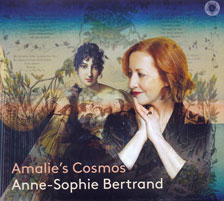
Née à Paris dans une famille franco-américaine, Anne-Sophie Bertrand découvre la harpe dès l’âge de cinq ans et révèle très tôt des dispositions exceptionnelles pour son instrument. Sa formation la conduit à la prestigieuse Royal Academy of Music de Londres auprès de Skaila Kanga, puis au Conservatoire royal de Bruxelles où elle obtient un master avec les plus hautes distinctions. Elle perfectionne ensuite son art auprès de personnalités majeures de l’école française de harpe, notamment Catherine Michel et Germaine Lorenzini. Cet enregistrement constitue l’aboutissement d’un véritable travail de recherche historique. En effet, Anne-Sophie Bertrand y ressuscite l’univers d’Amalie Beer (1767-1854), mère du compositeur Giacomo Meyerbeer et figure centrale de la vie culturelle berlinoise dont le salon accueillait artistes, savants, philosophes et musiciens. Autour de cette personnalité gravitent les œuvres de Fanny Mendelssohn (1805-1847), Pauline Viardot (1821-1910), Franz Liszt (1811-1886), Mikhail Glinka (1804-1857), Louis Spohr (1784-1859), Carl Maria von Weber (1786-1826), Claude Debussy (1862-1918) et d’autres créateurs (Albert Zabel, Niccolo Paganini, Elias Parish Alvars) liés directement ou indirectement à ce cercle intellectuel. Plusieurs pièces sont transcrites par la musicienne elle-même, démontrant son désir de faire de la harpe un véritable instrument orchestral capable d’embrasser des univers esthétiques très divers. Avec une maîtrise accomplie, Anne-Sophie Bertrand déploie un sens narratif particulièrement développé et une élégance de phrasé héritée de la grande tradition française, pour le plus grand plaisir du mélomane. Jean-Jacques Millo Born in Paris to a Franco-American family, Anne-Sophie Bertrand discovered the harp at the age of five and showed exceptional talent for the instrument from a very early age. Her training took her to the prestigious Royal Academy of Music in London, where she studied with Skaila Kanga, and then to the Royal Conservatory of Brussels, where she earned a master’s degree with the highest honors. She went on to refine her art under leading figures of the French school of harp, notably Catherine Michel and Germaine Lorenzini. This recording is the culmination of extensive historical research. Indeed, Anne-Sophie Bertrand brings to life the world of Amalie Beer (1767–1854), mother of the composer Giacomo Meyerbeer and a central figure in Berlin’s cultural life, whose salon welcomed artists, scholars, philosophers, and musicians. Centered around this figure are the works of Fanny Mendelssohn (1805–1847), Pauline Viardot (1821–1910), Franz Liszt (1811–1886), Mikhail Glinka (1804–1857), Louis Spohr (1784–1859), Carl Maria von Weber (1786–1826), Claude Debussy (1862–1918), and other composers (Albert Zabel, Niccolò Paganini, Elias Parish Alvars) directly or indirectly linked to this intellectual circle. Several pieces have been transcribed by the musician herself, demonstrating her desire to make the harp a true orchestral instrument capable of embracing a wide range of aesthetic worlds. With consummate mastery, Anne-Sophie Bertrand displays a particularly developed sense of narrative and an elegance of phrasing inherited from the great French tradition, much to the delight of music lovers.
Translation Lawrence Schulman |